Of all the 66 books in the library of the Bible, why would I choose to start the new year in Habakkuk, that mini book tucked in the Old Testament between Nahum and Zephaniah? And what’s with these names anyway?
The reason I chose to start my Bible reading and journaling in Habakkuk this year is because I was so fascinated by the text my pastor, Pastor CJ Johnson, used from Habakkuk in his New Year sermon. I imagine you’re wondering like I was, “why, why, why would one use Habakkuk as a New Year sermon outline?” But Pastor’s message was beautiful perfection. Read on.
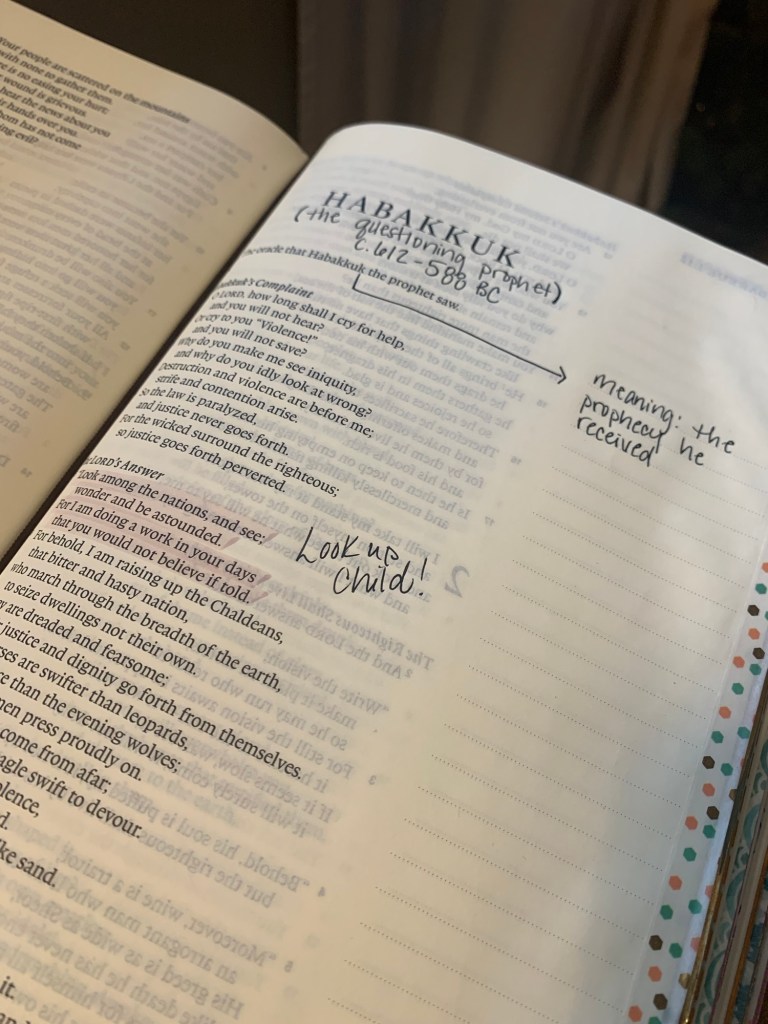
Habakkuk was nicknamed “the questioning prophet.” And in my Bible (ESV), the scripture headings describe Habakkuk’s complaints to God. Complaining to God!? Isn’t that some kind of sin? I don’t think so. If you magnify in on scripture as a whole, you’ll identify several individuals who were bold and authentic and audacious with God (think Moses, David, Peter). God is big enough to take our complaints, questions, and emotions; He welcomes them even.
Historically, Habakkuk lived prior to the Babylonian exile. The book of Habakkuk was written c. 612-588 B.C., according to my Life Application Study Bible. So, Habakkuk, questioning prophet, here, is crying out to God for help. He’s complaining that God isn’t hearing and seeing and saving. Faithful as always, God answers Habakkuk’s questions with a vision of what will take place during the Babylonian exile.
I know, I know; this blog is getting a bit teach-y. So, let’s get back to Pastor’s sermon. After God’s answer, Habakkuk questions God further. He was persistent. At the end of Habakkuk’s second complaint, he declares to God in Habakkuk 2:1 (ESV),
“I will take my stand at my watchlist and station myself on the tower, and look out to see what he will say to me, and what I will answer concerning my complaint.”
In the days of the prophets, the word “watchtower“ was used to refer to the prophets’ attitude of expectation (Isaiah 21, Jeremiah 6, Ezekiel 3). And here is where Pastor masterfully tied this passage into our New Year message. Using Habakkuk’s statement, Pastor challenged us to:
•ELEVATE our perspective
•EXTEND our perspective
•EXPAND our perspective
Doesn’t that just light your heart on fire? Setting goals, making resolutions, and daily decisions can all benefit from perspective elevation, extension, and expansion. And these three perspective shifts can be used in all areas of our lives—spiritual, physical, mental, financial, relational, and emotional!
As I read through Habakkuk, I got to the last three verses of the very last chapter, chapter 3. These last 3 verses come at the tail end of Habakkuk’s prayer-response to God, and record his praise to God even though he knows the devastation on the horizon.
Verse 17 begins “THOUGH the fig tree should not blossom…and the fields yield no food…and there be no herd in the stalls, YET will I rejoice in the Lord… (emphasis mine). Here, there’s a cause and effect—though devastation is coming, yet, still, even so, I will rejoice. Habakkuk is choosing joy.
He is choosing to focus on the miracles rather than the miseries.
Finally, Habakkuk brings his prayer to a close by acknowledging that God is his strength in this poetic prayer:
“God, the Lord, is my strength; he makes my feet like the deer’s; he makes me tread on my high places” (3:19).
And just like Habakkuk, I can be confident that if I keep my perspective elevated and focused on God, He will keep me surefooted and steadfast. For someone terrified of heights, this verse is a promise I carry close.
So, how about it this year? How about joining me and my friends at Hearth & Hive in shifting our perspectives this year? What does that look like for you?
Join me in choosing to mark year 2024 by the miracles rather than the miseries. 💛






 Hearth & Hive